TLDR: Four of the six tools fabricated statistics. Only one produced a deck suitable for client presentation without substantial rework. The gap between “generates slides” and “generates consulting deliverables” remains significant.
The Test Setup
According to McKinsey research, consultants spend between 20-40% of billable hours building presentations. A Medium study found accuracy rates across six AI presentation tools ranged from “0% to 44%.”
The AI presentation software market is projected to exceed $1.5 billion by 2027. Six tools were selected: Gamma, Beautiful.ai, Canva AI, SlidesAI, Tome, and Marvin. Each received the same brief:
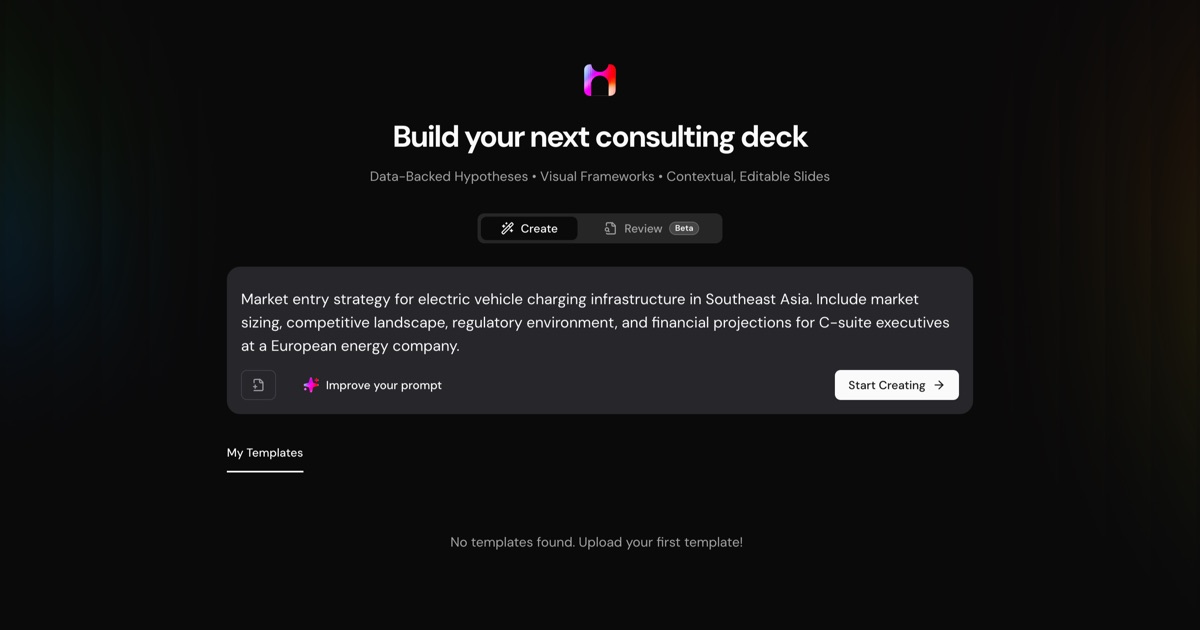
“Create a 12-slide market entry strategy presentation for electric vehicle charging infrastructure in Southeast Asia. Include market sizing, competitive landscape, regulatory environment, recommended entry strategy, and financial projections. Target audience: C-suite executives at a European energy company.”
All tools used default settings. The ASEAN EV market reached $4.55 billion in 2025 with projected growth of 32.61% annually through 2030, providing a data-rich test case.
Scoring Criteria
Six dimensions were evaluated using 1-to-10 scales:
- Citation accuracy (25% weight) — Sources verified against primary materials
- Brand compliance (15% weight) — Custom template ingestion and formatting consistency
- Narrative structure (20% weight) — Logical consulting frameworks like the Pyramid Principle
- Research depth (20% weight) — Sector-specific insights beyond surface summaries
- Export fidelity (10% weight) — Clean conversion to PowerPoint/Google Slides
- Speed (10% weight) — Time from prompt to finished deck
Results
| Criterion | Gamma | Beautiful.ai | Canva AI | SlidesAI | Tome | Marvin |
|---|---|---|---|---|---|---|
| Citation accuracy (25%) | 2/10 | 1/10 | 1/10 | 1/10 | 2/10 | 9/10 |
| Brand compliance (15%) | 3/10 | 5/10 | 4/10 | 3/10 | 4/10 | 9/10 |
| Narrative structure (20%) | 5/10 | 4/10 | 3/10 | 3/10 | 6/10 | 8/10 |
| Research depth (20%) | 4/10 | 3/10 | 2/10 | 2/10 | 5/10 | 8/10 |
| Export fidelity (10%) | 5/10 | 6/10 | 4/10 | 7/10 | 3/10 | 8/10 |
| Speed (10%) | 9/10 | 8/10 | 8/10 | 7/10 | 8/10 | 6/10 |
| Weighted Total | 3.9 | 3.6 | 2.8 | 2.8 | 4.2 | 8.3 |
Four of six tools scored below 4.0 on consulting-specific criteria. Five of six scored 2 or lower on citation accuracy.
Tool-by-Tool Analysis
Gamma
Gamma produced visually polished output in under 90 seconds. However, it cited no sources for market data. The Southeast Asian EV market figure was 40% higher than published estimates. Three slides contained unattributed statistics presented as definitive facts.
The narrative structure was sequential but flat—each slide addressed a topic without building cumulative argument. No executive summary or strategic recommendation. The deck resembled a Wikipedia overview rather than strategic counsel. PowerPoint export defaulted to non-standard slide proportions requiring manual adjustment.
Tome
Tome scored highest among generic tools on narrative structure and research depth. Before pivoting away from presentations in early 2025, Tome distinguished itself through storytelling-oriented approaches that structured slides around narrative arc.
The produced deck had recognizable argument flow: market context, opportunity sizing, competitive barriers, recommended approach, risk mitigation. Content showed synthesis rather than mere listing. However, Tome shared citation gaps: two statistics appeared fabricated, including a specific Thailand EV charging station count and a revenue projection attributed to a non-locatable report. Export to PowerPoint produced broken layouts and misaligned elements.
Beautiful.ai
Beautiful.ai offered the cleanest design system with smart templates adjusting spacing and alignment automatically. For brand-conscious teams working within its design system, visual output was strong.
Consulting gaps mirrored competitors: no citations, market data appearing generated from training rather than current sources. The narrative structured topics without connecting argument. No answer to “should this company enter?” Export to PowerPoint was functional but required manual cleanup, with graphics becoming uneditable post-conversion.
Canva AI, SlidesAI, and the Long Tail
Both scored 2.8 weighted—lowest in the test. Canva AI generated text-heavy slides with large paragraph blocks; a 100-character prompt limit constrained specificity. Output was generic enough for any emerging market, lacking Southeast Asia-specific insights.
SlidesAI, a Google Slides add-on, produced template-looking output with rigid “four bullets with image” patterns regardless of content type. Content was thin and research generic. Its advantage: export fidelity to Google Slides ranked highest since the tool generates natively there. Neither produced client-delivery-ready output without complete rework.
Key Findings
Citation accuracy is the critical gap. Five of six tools produced unverified or fabricated statistics. This aligns with recent studies finding 0-44% accuracy across AI presentation tools. For consulting, where single bad data points undermine entire engagements, this is disqualifying.
Speed is solved; quality is not. Every tool generated decks in under three minutes. Knowledge workers spend approximately “23% of their time verifying AI-generated content before use,” according to IDC research. A deck created in 60 seconds requiring four hours of fact-checking provides no productivity gain.
Narrative structure separates tools more than visual design. Visual adequacy appeared consistent across all six. Consulting deliverables differ from generic decks through argument flow, not appearance. Only Tome and Marvin produced decks with recognizable consulting narrative structure.
Brand compliance remains an afterthought. Five tools offered only their own template libraries. For firms requiring specific brand identities on all deliverables, this means manual reformatting after every generation.
The “good enough” trap is real. Visual polish from Gamma and Beautiful.ai created false completion sense. Slides looked professional, data sounded credible, formatting appeared clean. Yet beneath surface lay shallow, unsourced, structurally flat content.
What This Means for Consulting Teams
The test results reveal clear market division. One side comprises speed and visual appeal tools: Gamma, Beautiful.ai, Canva AI, SlidesAI—serving marketing teams and educators well. The other emphasizes accuracy and rigor—a much smaller category.
67% of consulting firms were piloting or deploying AI tools for client deliverables as of 2025, according to Forrester research. Three questions matter more than feature lists:
-
Does the tool verify its own claims? Without citation for every factual claim traceable to real, current sources, manual verification steps may eliminate time savings.
-
Does it support your brand template? Inability to upload firm PowerPoint masters and receive matching output requires reformatting. For firms producing dozens of monthly deliverables, this compounds costs.
-
Does it structure arguments or arrange topics? Consulting decks differ from topic overviews through narrative structure. Tools understanding frameworks like Pyramid Principle and hypothesis-driven storytelling meet consulting standards; flat bullet sequences do not.
Harvard Business Review analysis notes that common mistakes in AI tool evaluation involve “speed benchmarks rather than output quality metrics.” Marvin combined citation-first generation, brand template ingestion, and consulting-focused narrative frameworks. It scored 8.3 weighted. The authors acknowledge inherent bias and encourage independent testing using identical methodology.
The broader insight: “AI presentation tool” labeling is misleading in suggesting uniformity. These tools serve fundamentally different use cases despite shared labels. Choosing incorrectly doesn’t merely produce suboptimal output—it produces professionally appearing but factually wrong content, the most dangerous failure type in trust-based professions.