TLDR: Building a board pack from data room documents is one of the most time-intensive tasks in M&A advisory. The traditional workflow, reading hundreds of pages, extracting key findings, synthesizing themes, and formatting slides, takes a deal team two to three days. AI-assisted workflows compress this to hours by automating document ingestion, insight extraction, and structured slide generation while keeping the analyst in control of deal judgment and narrative framing.
Introduction
Every M&A transaction produces a data room. Hundreds of documents arrive in varying formats: financial statements in PDF, operational reports in Word, projections in Excel, management presentations in PowerPoint. The deal team’s job is to consume this material, identify what matters, and distill it into a board pack that enables a go or no-go decision.
This is grunt work that demands precision. A missed liability buried on page 47 of a vendor contract can change the economics of a deal. A misquoted revenue figure in the board pack can erode the investment committee’s trust in the entire analysis. The stakes are high, the volume is large, and the timeline is always compressed.
Board pack: A structured presentation delivered to a board of directors or investment committee summarizing the findings, risks, and recommendations from a due diligence process. Typically 20 to 40 slides covering financial performance, market position, operational risks, legal exposures, and the investment thesis.
AI does not eliminate the need for deal judgment. What it does is compress the mechanical phases of the workflow, reading, extracting, formatting, so that analysts spend their time on the intellectual work that actually determines deal outcomes.
The Traditional Workflow: Five Phases
Understanding where AI creates leverage requires mapping the traditional workflow that deal teams follow today.
Phase 1: Document Ingestion and Triage
The data room opens and the team downloads everything. Documents number in the hundreds, sometimes thousands. The first task is triage: sorting documents by category (financial, legal, operational, commercial), identifying which are critical path and which are supplementary, and flagging gaps where expected documents are missing.
This phase is manual, tedious, and surprisingly error-prone. Documents are often mislabeled, duplicated across folders, or provided in scanned PDF format that resists text search. A junior analyst can spend an entire day just organizing and cataloging the data room contents before any substantive analysis begins.
Phase 2: Document Review and Note-Taking
Each critical document gets read and annotated. The analyst extracts key data points: revenue figures, customer counts, contract terms, liability disclosures, capex commitments. Notes are taken in spreadsheets, Word documents, or the analyst’s preferred system. Cross-references are tracked manually: “The revenue figure on page 12 of the management presentation contradicts the audited financials on page 34 of the annual report.”
For a mid-market deal with 200 to 400 documents, this phase consumes 40 to 80 analyst-hours. The cognitive load is substantial: the analyst must maintain context across dozens of documents while identifying inconsistencies, risks, and opportunities that span multiple sources.
Phase 3: Insight Synthesis
Raw notes become structured findings. The analyst groups observations into themes: financial performance trends, customer concentration risk, regulatory exposure, operational scalability. Each theme requires a judgment call: is this a deal-breaker, a negotiation point, or a manageable risk? The synthesis phase is where analyst expertise matters most, but it is bottlenecked by the mechanical work of phases one and two.
Phase 4: Slide Construction
Findings are translated into slides. Each slide must make one clear point, supported by data extracted from the source documents. Charts are built from financial data. Key quotes are pulled from legal documents. Risk matrices are populated from operational assessments. A typical board pack requires 20 to 40 slides, and each slide involves formatting, layout, and iterative review.
For most deal teams, slide construction is the most time-consuming phase relative to its intellectual content. The analyst already knows what the slide should say. The bottleneck is the mechanical work of building it in PowerPoint: aligning text boxes, formatting tables, ensuring consistent fonts, and matching the firm’s brand template.
Phase 5: Review and Iteration
The draft board pack goes through multiple review cycles. A senior associate or director reviews for accuracy and completeness. A partner reviews for narrative and strategic framing. Each review cycle generates comments that require revisions, additional data pulls, and re-formatting. Two to three review cycles are typical, each consuming half a day.
The total elapsed time from data room access to final board pack: two to three days for a deal team of three to four people. That is 80 to 120 person-hours of work, the majority spent on reading, extracting, and formatting rather than on the strategic analysis that the board actually needs.
Where AI Changes the Equation
AI does not replace the five-phase workflow. It compresses each phase by automating the mechanical components while preserving human control over judgment and narrative.
Stage 1: Automated Document Ingestion
AI tools with document processing capabilities can ingest the entire data room in minutes. PDFs, DOCX, XLSX, and PPTX files are parsed, OCR is applied to scanned documents, and content is indexed for search and retrieval. The output is a searchable, structured representation of the entire data room.
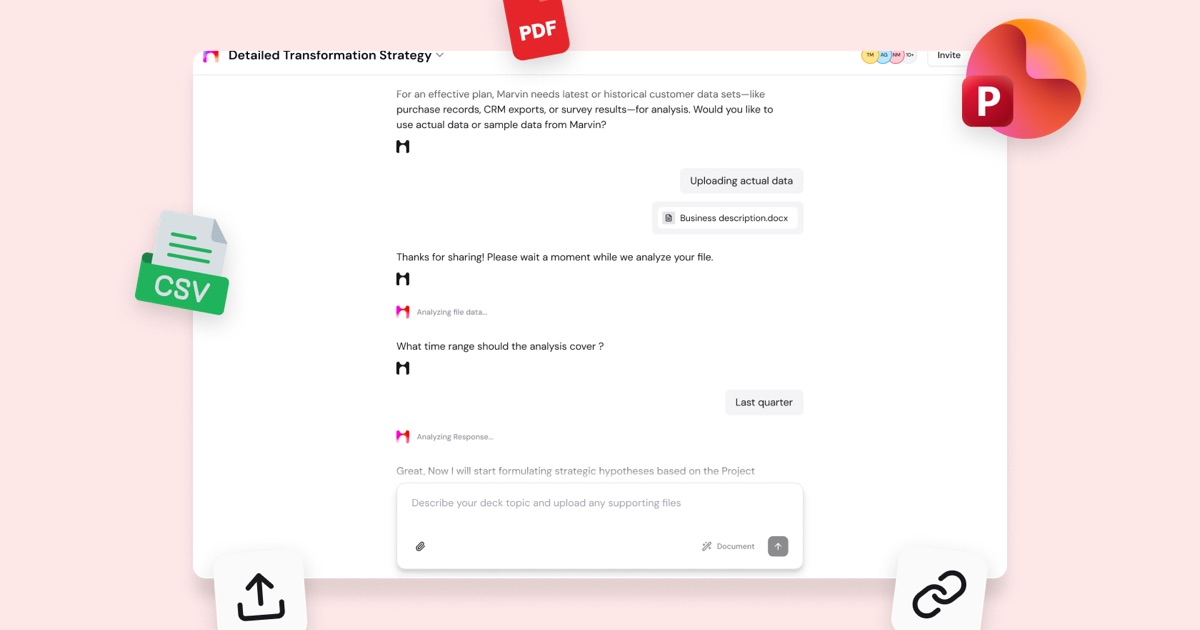
Marvin processes uploaded documents through its parsing pipeline, extracting text, tables, and figures while preserving document structure. The result is not a flat text dump but a structured index that understands page boundaries, section headers, and table relationships. This means the AI can later retrieve “the revenue table on page 12 of the annual report” rather than just “text that mentions revenue.”
What previously took a junior analyst an entire day of downloading, sorting, and cataloging now happens in the time it takes to upload the files.
Stage 2: AI-Assisted Document Review
With the data room indexed, the analyst can query documents conversationally rather than reading them sequentially. Instead of reading 400 pages to find all references to customer concentration, the analyst asks: “What are the top 10 customers by revenue contribution, and what contract terms govern each relationship?”
The AI retrieves relevant passages from across the data room, presents them with source citations, and highlights inconsistencies between documents. The analyst reviews the AI’s extractions, validates them against the source, and adds their own judgment. A document review that took 40 to 80 hours manually now takes 8 to 16 hours, with the analyst focused on evaluation rather than extraction.
Citation-first architecture is critical here. Every extracted data point must link back to the specific document and page where it originated. In due diligence, the chain of evidence from source document to board pack slide must be unbroken. An AI tool that generates plausible-sounding summaries without traceable citations is worse than useless in this context because it creates false confidence.
Stage 3: Structured Insight Synthesis
The AI assists with pattern recognition across documents. It identifies themes that span multiple sources: “Three separate documents reference pending litigation related to the 2024 product recall.” It flags numerical inconsistencies: “The management presentation shows Q3 revenue of $12.4M, but the audited interim financials show $11.8M.”
The analyst still makes the judgment calls. Is the litigation material? Is the revenue discrepancy a timing difference or an error? But the AI surfaces the raw material for these judgments faster and more completely than manual review. Cross-document analysis that might take an experienced analyst a full day is compressed to hours.
Stage 4: Automated Slide Generation
This is where the time savings compound most dramatically. Once findings are synthesized, the AI generates board pack slides that follow the firm’s template, present one finding per slide with supporting data, and cite every data point back to its source document.
Marvin’s approach here is to take the structured findings from the synthesis phase and generate slides that conform to the uploaded brand template. Each slide follows consulting conventions: an action title stating the key finding, supporting data in the body, and source citations linking back to the original documents. The analyst reviews and edits the generated slides rather than building them from scratch.
A 30-slide board pack that previously required eight to twelve hours of PowerPoint work can be generated in minutes and refined in two to three hours. The analyst’s time shifts from formatting to reviewing and refining the narrative.
Stage 5: Streamlined Review Cycles
AI-generated slides with embedded citations make the review process faster and more focused. A reviewing partner can click any data point to see the source document and verify the claim in seconds. Questions like “Where did this revenue figure come from?” are answered by the citation trail, not by the analyst searching through notes.
Review comments can be addressed more quickly because regenerating a slide with revised emphasis or additional data is faster than manual PowerPoint editing. The typical two to three review cycles still happen, but each cycle is compressed from half a day to a few hours.
A Practical Example: Fintech Acquisition Due Diligence
Consider a private equity firm evaluating a mid-market fintech acquisition. The data room contains 280 documents: audited financials for three years, management projections, customer contracts, regulatory filings, technology architecture documentation, and HR records.
Traditional workflow: A team of four (two analysts, one associate, one director) spends three days. Analysts read and extract for two days. The associate synthesizes findings. The director builds the board pack narrative. Total: approximately 100 person-hours.
AI-assisted workflow: The team uploads all 280 documents to Marvin. Document ingestion and indexing takes 15 minutes. Analysts use conversational queries to extract findings across the data room over four hours, focusing on financial performance, customer concentration, regulatory risk, and technology scalability. The associate reviews AI-synthesized themes and adds deal judgment in two hours. The director generates the board pack from structured findings in 30 minutes and refines the narrative over two hours. Total: approximately 35 person-hours.
The 65% reduction in person-hours is significant, but the qualitative improvement matters equally. The AI-assisted workflow produces a board pack where every data point is traceable to its source document. The review partner can verify any claim in seconds. The narrative is structured around the investment thesis rather than organized by document category. And the team spent their time on deal judgment rather than on reading and formatting.
The Productivity Evidence
The efficiency gains observed in M&A workflows are consistent with broader research on AI-assisted knowledge work. A Harvard Business School and BCG experiment found that consultants using AI completed tasks 25% faster with 40% higher quality scores on realistic consulting deliverables. McKinsey’s internal deployment of their AI tool Lilli reportedly reduced research time by 30% across their consulting teams.
For deal teams specifically, the leverage is even higher because of the document-intensive nature of due diligence. The traditional workflow front-loads enormous manual reading and extraction work before any strategic analysis begins. AI inverts this ratio: the mechanical work is compressed, freeing capacity for the intellectual work that determines deal outcomes.
IDC research found that knowledge workers spend approximately 23% of their time verifying AI-generated content before use. For due diligence, this verification time is well spent because accuracy is non-negotiable. But with citation-first tools, verification means checking a linked source document, not re-reading the entire data room. The verification phase is measured in minutes per claim, not hours per document.
What AI Cannot Replace
Intellectual honesty requires acknowledging the boundaries. AI compresses the mechanical phases of due diligence workflows, but several critical functions remain firmly human.
Deal judgment. Determining whether a risk is material, whether a growth trajectory is sustainable, or whether a management team is credible requires experience and intuition that AI does not possess. The AI can surface that the target company lost three VP-level executives in the past year. The analyst determines whether that signals organizational dysfunction or normal turnover.
Narrative framing. A board pack is not a neutral summary. It is a persuasive document that frames findings within an investment thesis. The narrative must anticipate the investment committee’s concerns, address them proactively, and build toward a clear recommendation. This requires understanding the audience’s priorities, risk appetite, and decision-making style, context that no AI tool currently captures.
Relationship context. Due diligence exists within a deal process that involves negotiations, management meetings, and relationship dynamics. The board pack must reflect not just what the documents say but what the deal team learned through direct interaction. A management team’s body language during the operational walkthrough does not appear in any data room document.
Ethical and regulatory judgment. Flagging a potential FCPA violation, identifying aggressive revenue recognition, or spotting a regulatory red flag requires domain expertise and professional judgment. AI can surface anomalies; humans must evaluate their significance within the legal and ethical context of the specific transaction.
The most effective workflow treats AI as a force multiplier for the analyst’s capabilities, not as a replacement for the analyst’s judgment. The analyst who previously spent 60% of their time on mechanical extraction and 40% on strategic analysis can now invert that ratio, spending the majority of their time on the work that actually determines whether the deal is worth doing.
Choosing the Right Tool for M&A Workflows
Not every AI presentation tool is suitable for due diligence workflows. The requirements are more demanding than general presentation generation because of the sensitivity of the content, the importance of accuracy, and the document-heavy nature of the work.
Document processing capability. The tool must handle PDFs, DOCX, XLSX, and PPTX files, including scanned documents requiring OCR. It must preserve document structure, tables, and figures rather than producing flat text extractions. Marvin’s parsing pipeline handles all standard data room formats and maintains structural relationships within documents.
Citation-first architecture. Every data point in the generated board pack must link back to the source document and page. This is not a nice-to-have feature. In due diligence, the chain of evidence from data room to board pack must be auditable. Tools that generate plausible summaries without traceable citations create liability rather than reducing it.
Brand template support. The board pack must match the firm’s visual identity. Uploading the firm’s PowerPoint master template and receiving formatted output eliminates the hours spent on manual formatting. For firms producing multiple board packs per quarter, this compounds into significant time savings.
Enterprise security. Data room contents are among the most sensitive documents a firm handles. The AI tool must offer encryption at rest and in transit, no training on customer data, role-based access controls, and audit logging. SOC 2 Type II certification is the minimum standard for enterprise procurement.
Conversational document interaction. The ability to query uploaded documents conversationally, rather than relying solely on keyword search, transforms the document review phase. The analyst should be able to ask complex, cross-document questions and receive cited answers.
The gap between generic AI presentation tools and purpose-built solutions for professional services is most visible in M&A workflows. A tool that generates attractive slides from a text prompt serves marketing teams well. A tool that ingests 280 documents, extracts and cross-references findings, generates cited board pack slides in a firm’s brand template, and maintains an auditable evidence trail serves deal teams. These are fundamentally different products despite sharing the “AI presentation” label.