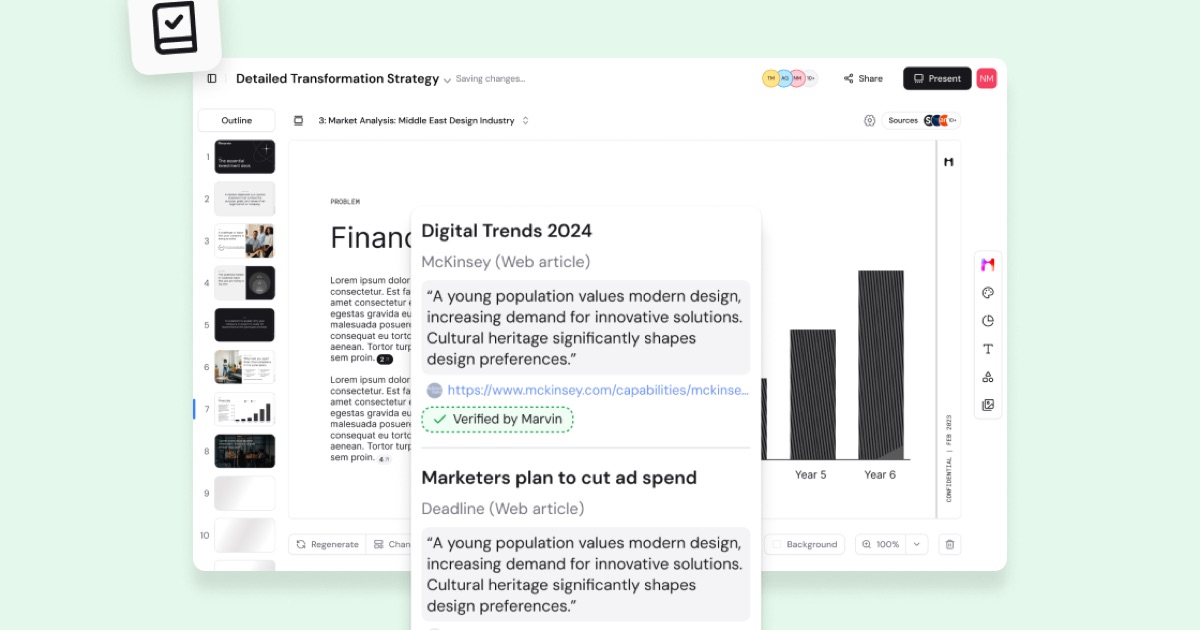
TLDR: Conventional AI presentation tools generate flat bulleted lists because they lack structural frameworks. The Pyramid Principle, MECE, and SCQA provide logical scaffolding that produces hypothesis-driven consulting decks instead of generic slide filler. This guide demonstrates how to apply these frameworks to AI prompts and explains how Marvin extracts this structure automatically through context questions.
Why AI Tools Produce “Bullet-Point Soup”
The structural problem with AI-generated presentations is not about design—it is about logic. When you prompt ChatGPT, Claude, or Gamma with “create a presentation on digital transformation,” the model predicts the next most likely token. Language models do not understand document structure the way humans do, and their outputs frequently contain structural inconsistencies and repetitive ideas. The output is a sequence of plausible points arranged in the order they were generated, not in the order that builds an argument.
This produces what consultants call “bullet-point soup”: slides full of true but unstructured observations that lack a governing thesis, logical grouping, or narrative progression. AI content often lacks depth, nuance, and genuine human perspectives, with many outputs offering little more than repackaged information that rarely brings new aspects into discussion.
Root Causes
No top-down logic. LLMs generate sequentially, left to right. They do not start with a conclusion and work backward to identify what supports it. A consulting deck requires the opposite: define the recommendation first, then select only the evidence that supports or qualifies it.
No awareness of slide relationships. Generic tools treat each slide as an independent unit. Slide four does not know what slide three established. Each consulting slide must convey one key message through an action title, and slides must connect to form a cohesive storyline. AI tools have no such mechanism: there is no concept of “this slide builds on the previous one” or “these three slides collectively prove a single point.” The result is a flat sequence rather than a structured argument.
No framework enforcement. When a consultant builds a deck manually, they apply the Pyramid Principle, SCQA, or a thesis-led structure instinctively. AI tools have no such default. Without explicit structural instructions, they fall back to the simplest pattern: a title and three to five bullet points per slide.
No strategic filtering. A well-structured deck excludes irrelevant information as deliberately as it includes relevant information. AI tools, optimized for completeness, tend to include everything tangentially related to the topic. The result is comprehensive but unfocused.
The Pyramid Principle Explained for AI Context
Barbara Minto published The Pyramid Principle in 1987, and it remains required reading at top consulting firms. The framework rests on three rules:
Rule 1: Start with the answer. The governing thought, your main recommendation or conclusion, goes at the top of the pyramid. Every element below it exists to support this single point. In a presentation, this means your executive summary slide states the recommendation before any analysis appears.
Rule 2: Group and summarize. Supporting arguments are organized into clusters of three to five points. Each cluster has its own summary statement, which in turn supports the governing thought. In slide terms, each section of your deck has a clear section header that connects back to the main thesis.
Rule 3: Logically order within groups. Within each cluster, points follow a logical sequence: time order (first, then, finally), structural order (geography, division, process step), or degree order (most important to least). The choice of order depends on the content, but the presence of an order is mandatory.
When applied to AI-generated presentations, the Pyramid Principle transforms the prompting process. Instead of asking “create a presentation about X,” you define the governing thought first: “The recommendation is Y, supported by three arguments: A, B, and C. Create a deck that proves this thesis.”
This single shift eliminates most list-based filler. The AI now has a structure to fill instead of a blank canvas to cover.
SCQA: The Narrative Engine Behind Every Good Deck
While the Pyramid Principle governs the logical structure of a deck, SCQA provides the narrative arc. SCQA stands for Situation, Complication, Question, Answer, and it was also developed by Barbara Minto as part of her work on structured communication. Top consulting firms use SCQA to write executive summaries in their slide decks.
Situation: The current state that your audience already agrees with. Example: “Our firm has grown 15% annually for the past three years through organic expansion in North America.”
Complication: The change or problem that disrupts the situation. Example: “However, the North American market is reaching saturation, and growth has decelerated to 8% in Q3.”
Question: The strategic question raised by the complication. Example: “How should we sustain double-digit growth over the next five years?”
Answer: Your recommendation. Example: “Expand into three Southeast Asian markets by Q4, targeting the mid-market segment with a localized go-to-market strategy.”
SCQA gives AI tools something they desperately need: a reason for the presentation to exist. Without SCQA, a prompt like “create a deck about Southeast Asian expansion” produces a generic overview. With SCQA, the same topic becomes a directed argument with stakes, tension, and resolution.
The variant SCR (Situation, Complication, Resolution) drops the explicit Question and is common in executive summaries where the audience is expected to infer the question. McKinsey executive summaries consistently follow this SCR structure to create urgency and direction in the opening slides of a deck.
For AI prompting, SCQA is powerful because it constrains the model’s output at every stage. The Situation section must contain only established facts. The Complication must introduce genuine tension. The Answer must directly address the Question. This chain of constraints prevents the model from drifting into generic filler.
MECE: Why Mutual Exclusivity Matters in AI Outputs
MECE (Mutually Exclusive, Collectively Exhaustive) is the quality standard that makes both the Pyramid Principle and SCQA work. Barbara Minto coined the term during her time at McKinsey, and according to her: “I invented it, so I get to say how to pronounce it” (she says “me-see”).
Mutually Exclusive means no overlap between categories. If your three supporting arguments for market expansion are “revenue opportunity,” “competitive positioning,” and “financial upside,” you have a problem: revenue opportunity and financial upside overlap significantly. A MECE version might be: “market size and growth trajectory,” “competitive landscape and entry barriers,” and “operational requirements and timeline.”
Collectively Exhaustive means no gaps. Your categories must cover the complete scope of the question. If you are analyzing market entry options and only address organic growth and acquisition but ignore partnership or licensing models, you are not exhaustive.
The framework ensures that team members can divide work cleanly (because categories do not overlap) and that root causes cannot be missed (because the categories cover everything).
AI tools struggle with MECE for a specific reason: language models are optimized for fluency, not logical partitioning. When you ask an LLM to “list the key factors for market entry,” it generates factors based on token probability, not based on whether they are mutually exclusive. The result is often redundant: “market size” and “demand” appear as separate points even though they overlap heavily.
To enforce MECE in AI outputs, you need to either define the categories yourself in the prompt or use a tool that applies MECE validation after generation. Experienced consultants pre-define their MECE categories before building any slide, and the same discipline must be applied when prompting AI. Simply asking the AI to “make it MECE” is unreliable because the model may not correctly evaluate mutual exclusivity across its own outputs.
How to Get Structured Outputs from AI
There are two paths to structured AI presentations: manual prompting with frameworks, and purpose-built tools that enforce structure automatically.
Manual Prompting with Frameworks
If you are using ChatGPT, Claude, or any general-purpose LLM, you can apply the Pyramid Principle, SCQA, and MECE through careful prompt engineering. Prompt specificity directly determines output quality, and vague prompts consistently produce unfocused results.
The key is to provide the structure in the prompt, not hope the model discovers it:
- State the governing thought first. Tell the AI your conclusion before asking it to build the deck.
- Define the SCQA arc. Provide the Situation, Complication, and Question explicitly. Let the AI elaborate the Answer.
- Specify MECE categories. Name your three to five supporting argument groups instead of letting the AI choose them.
- Constrain each slide. Specify that each slide should make one claim, supported by evidence, with a clear connection to the governing thought.
This works but requires significant consulting expertise from the person writing the prompt. You need to know the Pyramid Principle to apply it, which limits the approach to experienced practitioners.
Marvin’s Context Questions Approach
Marvin takes a different approach. Instead of requiring the user to embed consulting frameworks into their prompt, Marvin’s agent asks 3 to 5 structured context questions before generating any content.
These questions extract the specific information that frameworks like the Pyramid Principle require:
- “What is the primary recommendation or conclusion?” This establishes the governing thought at the top of the pyramid.
- “Who is the audience and what decision are they making?” This sets the stakes and determines the appropriate level of detail.
- “What are the 3 to 4 key areas that support your recommendation?” This defines the MECE groupings before generation begins.
- “What is the current situation and what has changed?” This provides the Situation and Complication for the SCQA arc.
- “What specific data or evidence should be included?” This constrains the AI to verified information instead of generated filler.
By extracting this structure through conversation, Marvin builds a solution outline that follows deductive logic before a single slide is created. The generation phase then fills in the outline with verified content, ensuring every slide supports the governing thought and every section follows a logical sequence.
This is fundamentally different from tools that take a topic and generate slides sequentially.
Before and After: Generic Prompt vs. Structured Prompt
The difference between unstructured and structured AI prompting is dramatic. Structured prompts significantly reduce cognitive offloading and enhance both reasoning quality and reflective engagement compared to unguided AI use.
Generic Prompt (Produces Bullet-Point Soup)
“Create a 10-slide presentation about entering the Southeast Asian market for a SaaS company.”
Typical AI output: Slide 1: Title. Slide 2: “Overview of Southeast Asia” with five bullet points about GDP and population. Slide 3: “Market Opportunity” with four bullet points about digital adoption. Slide 4: “Challenges” with bullet points about regulations and language barriers. Slides 5 through 9: More loosely organized bullet points about competitors, pricing, marketing, hiring, and technology. Slide 10: “Conclusion” that restates slide 2.
This deck is a Wikipedia summary formatted as slides. It has no thesis, no argument, and no recommendation. Every slide could be rearranged without affecting the narrative because there is no narrative.
Structured Prompt (Produces a Hypothesis-Driven Deck)
“Create a 10-slide deck that argues: [Company] should enter Indonesia, Vietnam, and Thailand by Q4 with a localized mid-market SaaS offering, prioritizing Indonesia first.
Situation: [Company] has grown 15% annually through organic North American expansion. Complication: North American growth has decelerated to 8% as the market saturates. Question: How can we sustain double-digit growth over the next five years? Answer: Expand into three Southeast Asian markets with the highest SaaS adoption trajectories.
Supporting arguments (MECE):
- Market attractiveness: TAM, growth rates, digital infrastructure readiness
- Competitive landscape: incumbent weakness, entry barriers, partnership opportunities
- Execution plan: go-to-market sequence, localization requirements, resource allocation
Each slide should make one claim, supported by data, connecting back to the main recommendation.”
Resulting AI output: A deck with a clear recommendation on slide one, an SCQA-structured executive summary, three logically ordered sections that prove the thesis from different angles, and a closing slide that synthesizes the argument into actionable next steps.
The content is not just better organized. It is a different category of deliverable. The first version informs. The second version persuades.
How Structure Prevents AI Hallucination
There is a frequently overlooked benefit to structured prompting: it reduces hallucination. Constrained and structured prompts measurably reduce hallucination rates by narrowing the generation space and anchoring outputs to specific claims.
AI tools fabricate facts when they lack constraints. A vague prompt like “tell me about the Southeast Asian SaaS market” gives the model maximum freedom to generate plausible but unverifiable claims.
A structured prompt constrains the model at every level. The governing thought limits what is relevant. MECE categories limit what each section can contain. SCQA limits how the narrative unfolds. Even top-performing LLMs hallucinate in 1% to 30% of outputs depending on the task. Structured prompts reduce this range by narrowing the space of acceptable responses.
Marvin compounds this effect by pairing structural frameworks with citation-first generation. The context questions define what the deck must prove, and the research pipeline retrieves verified data to prove it. Structure and verification work together: structure tells the AI what to look for, and verification ensures what it finds is real.